🎨 Describing adjectives in CE2: how to spot and use them, with exercises
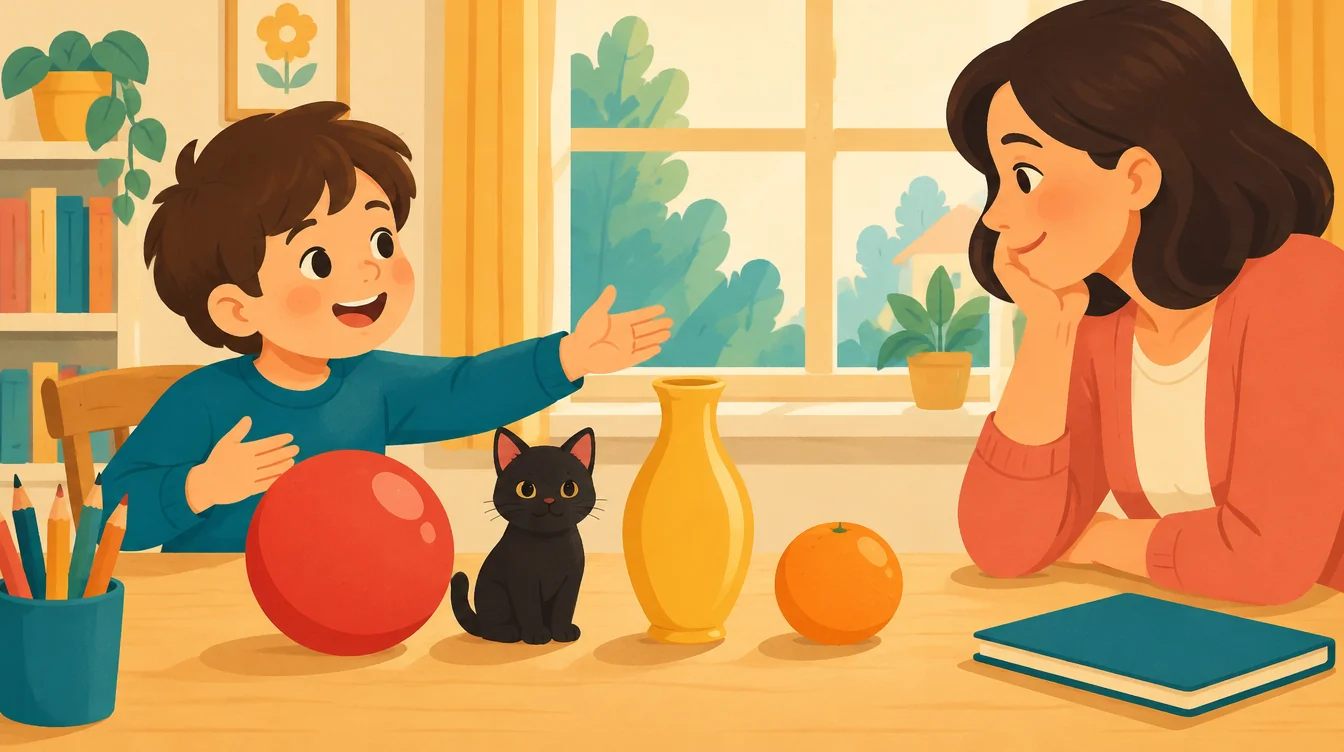
“Underline the describing adjectives.” This instruction comes up often in CE2, and your child might hesitate: is grand an adjective? And rouge? Here’s how you can help your child recognise adjectives with confidence, and then use them correctly. You’ll find practice exercises with answers at the end.
Describing adjectives in CE2: what are they for?
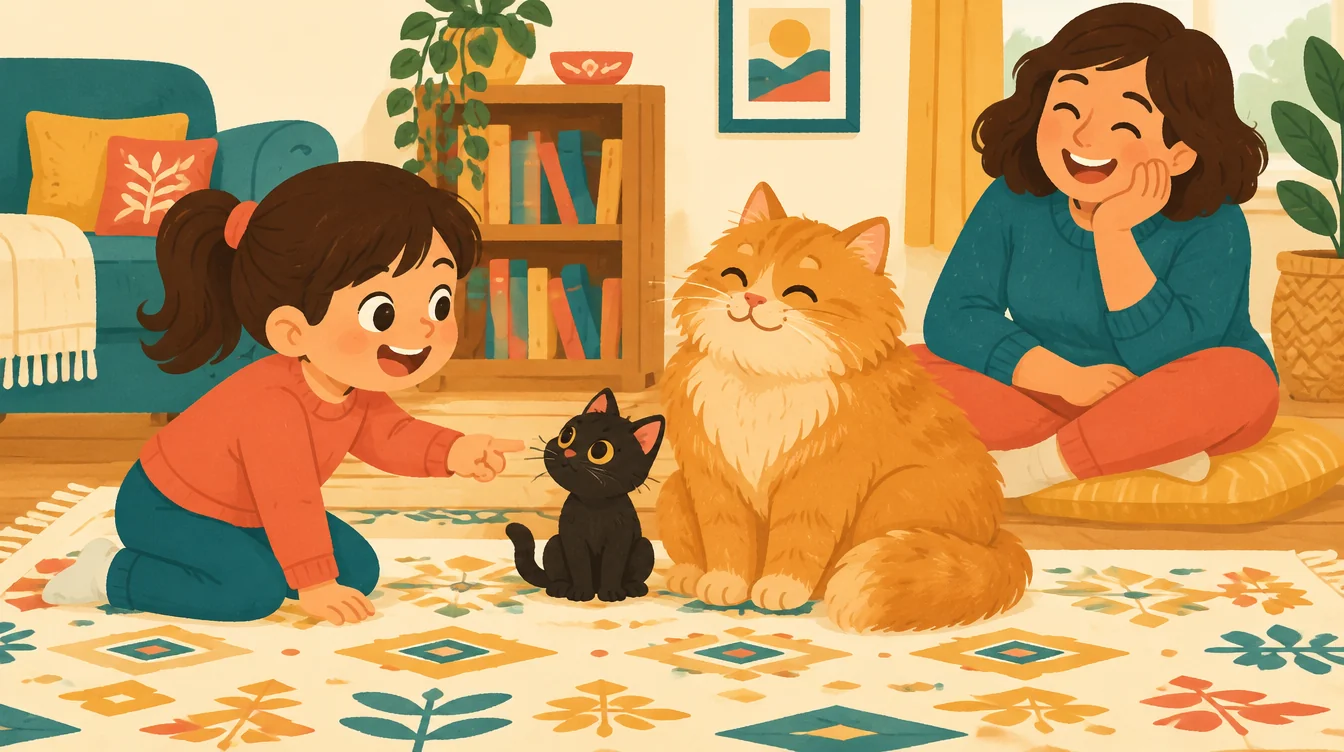
An adjective gives more detail about a noun: it tells you what a person, animal or thing is like. “Un chat” is vague. “Un petit chat noir” paints a clear picture.
In CE2, children are expected to name the main word classes, including nouns and adjectives, and to understand how words agree within a noun phrase: the determiner, noun and adjective all match. To review all the word classes, see our article on word types.
Don’t be surprised if the exercise book just says “adjective”: that’s the official term used in schools since 2020. “Describing” is mainly used to tell them apart from relational adjectives, like “présidentiel” in “la voiture présidentielle”.
How to spot it in a noun phrase: 3 quick tests
A noun phrase is a noun with its determiner and any words that go with it: “le grand chien”, “une maison blanche”. If determiners are still tricky, our article on determiners can help. To find the adjective, try these three tests:
- You can remove it. “Un petit chat noir” becomes “un chat”: the sentence still makes sense.
- You can swap it for another adjective. “Un petit chat” becomes “un gros chat”, “un chat noir” becomes “un chat roux”.
- It answers the question “What is it like?” What is the cat like? Petit et noir.
A little tip: you can often put “très” (very) in front (très petit, très gentil). With a noun, this usually doesn’t work: you wouldn’t say “très chat”.
Watch out for one case: in “Le chat est noir”, noir is still an adjective, but you can’t remove it. After the verb être, it acts as a subject complement—your child will learn to spot this in cycle 3 (CM1, CM2, 6e).
Making adjectives agree in gender
An adjective takes the gender of the noun it describes: masculine or feminine. Usually, you add -e: un grand jardin, une grande maison. If it already ends in -e, it stays the same: un pull rouge, une robe rouge.
Some endings change more. For example, the curriculum mentions joyeux, joyeuse.
| Masculine | Feminine | Example |
|---|---|---|
| petit, grand | + e | une petite fille |
| rouge, rapide | no change | une voiture rapide |
| -eux: joyeux | -euse: joyeuse | une fête joyeuse |
| -er: léger | -ère: légère | une plume légère |
| -f: sportif, neuf | -ve: sportive, neuve | une fille sportive |
| -on, -en, -el: bon, ancien, cruel | double the consonant: bonne, ancienne, cruelle | une bonne idée |
| beau, vieux, blanc, long, doux | belle, vieille, blanche, longue, douce | an old lady |
Making adjectives agree in number
In the plural, adjectives usually take an -s, even if you can’t hear it: un chat noir, des chats noirs. For feminine plural, add -e then -s: des petites filles.
- Adjectives ending in -s or -x: these don’t change. Un chat gris, des chats gris; un enfant joyeux, des enfants joyeux.
- Adjectives ending in -eau: these take -x. Un beau livre, de beaux livres.
- Adjectives ending in -al: most often become -aux. Un ami loyal, des amis loyaux. Some exceptions like banal (banals).
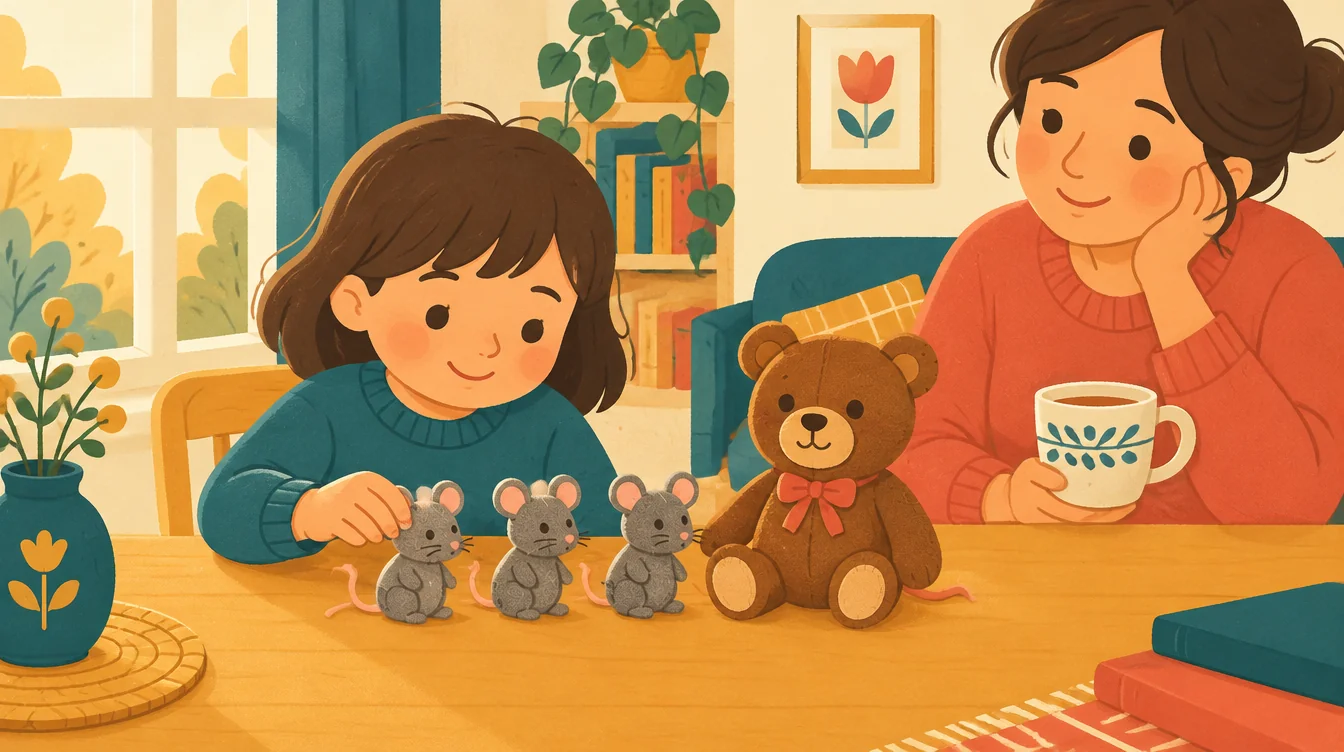
These rules are very similar to those for nouns: our article on the plural of nouns explains them in detail. You can spot the agreement chain at a glance: « les petites souris grises »—everything is feminine plural.
Common pitfalls with agreement
- Adjective before the noun. It still agrees: de jolies fleurs, de grands arbres.
- Adjective far from the noun. « Une boîte de crayons neufs »: it’s the pencils that are new. « Une boîte de crayons neuve »: it’s the box. Always ask: what is new?
- Two nouns together. The adjective goes in the plural. If both nouns are feminine, use the feminine plural: une jupe et une robe blanches. If there’s one masculine and one feminine, the masculine plural wins: un pantalon et une chemise blancs.
- Silent agreement. Des pommes rouges, des chats gris… nothing changes when you say it. In writing, always look for the noun and check.
Adjective agreement exercises CE2 (with answers)
1. Find the adjectives.
- a. Un petit chien noir court dans le grand jardin.
- b. La vieille dame porte un chapeau rouge.
- c. Ma sœur a une nouvelle trousse violette.
2. Make the adjective in brackets agree. a. une (gentil) maîtresse; b. des ballons (rond); c. des histoires (merveilleux); d. une (long) journée; e. de (beau) images; f. des filles (sportif).
3. Choose the correct agreement. a. un pull et une écharpe (chaud); b. une jupe et une robe (léger); c. une boîte de crayons (neuf), when it’s the box that’s just been bought.
Answers. 1. a. petit, noir, grand; b. vieille, rouge; c. nouvelle, violette. 2. a. gentille; b. ronds; c. merveilleuses; d. longue; e. belles; f. sportives. 3. a. chauds; b. légères; c. neuve.
To keep going, our printable CE2 exercises mark themselves. And to keep agreement rules handy during homework, the Filoumi Memory Tricks sum them up on a single illustrated page.
Want to put these tips into practice?
Every day, a new adventure workbook adapted to your child's school level — to print or do on screen. No commitment.
Your questions
How do you spot an adjective in CE2?
You can remove it without breaking the sentence, swap it for another adjective, and it answers the question “What is … like?”. In « un petit chat noir », petit and noir pass all three tests.
Should you say adjective or qualifying adjective?
Both are understood. The official 2020 grammar guidelines recommend just using « adjective » at school; « qualifying » is only to distinguish it from relational adjectives, like « présidentiel ».
Why do you write « un pantalon et une chemise blancs »?
When an adjective goes with two nouns, it takes the plural. If one is masculine and the other feminine, the masculine plural is used.
Does the adjective still agree when it comes before the noun?
Yes. Whether before or after the noun, it always matches in gender and number: de jolies fleurs, des fleurs jolies.
Read next
 Memory Tricks & Recall
Christmas poems for children: short texts to learn, from Kindergarten to CM2
Discover 9 Christmas poems for children from Kindergarten to CM2, with original and classic texts by Gautier and Verlain…
 Memory Tricks & Recall
Printable poems for CE1: a free collection, sorted by season
CE1 poetry: 12 short, copyright-free poems, organised by season, plus a method to learn a poem in 4 evenings and recite …
 Revision methods
The syllabic method for learning to read: why it’s making a comeback
The syllabic method for learning to read: how it differs from the global method, what the official recommendations say, …
 Memory Tricks & Recall
CE2 Conjugation: what you need to know and exercises to help remember it
CE2 conjugation: the 4 tenses on the curriculum, endings in a table, common pitfalls for each tense and corrected exerci…
 Revision methods
The Pomodoro Method for Children: Study in 10-Minute Bursts
Discover the Pomodoro technique for children, with ideal session lengths for CP, CE1, CE2, CM1, and CM2, plus timer tips…
 Memory Tricks & Recall
9 times table: the finger trick and other clever tips
The full 9 times table, step-by-step finger method, the digits adding up to 9, the ‘10 times minus 1 times’ trick, games…