➖ Subtraction with borrowing: both methods explained for parents

This evening, your child tries to solve 52 − 27 and gets stuck: “2 minus 7, I can’t do it!” You show them how you learned at school… and they reply, “That’s not how my teacher does it.” That’s normal: there are two ways to do subtraction with borrowing, and they’re written differently.
Here are both methods, explained using the same example, so you can recognise which one your child uses and help without confusing them.
Why subtraction with borrowing is tricky for so many children
In 52 − 27, you start with the units: 2 − 7. That’s impossible with whole numbers. Many children instinctively swap the numbers and do 7 − 2 = 5. That gives the wrong answer: 35 instead of 25.
Borrowing means understanding an abstract idea: a ten is made of 10 units, and you can exchange between them. If this isn’t clear, the method just becomes a series of mysterious steps that are quickly forgotten.
The CE1 curriculum introduces a written subtraction method by period 3 at the latest, between the Christmas and winter holidays. It also states that the same method should be used throughout the school, from CE1 to CM2: either the 'breaking apart' method or the 'compensation' method.
Before you start: swap a ten for 10 units
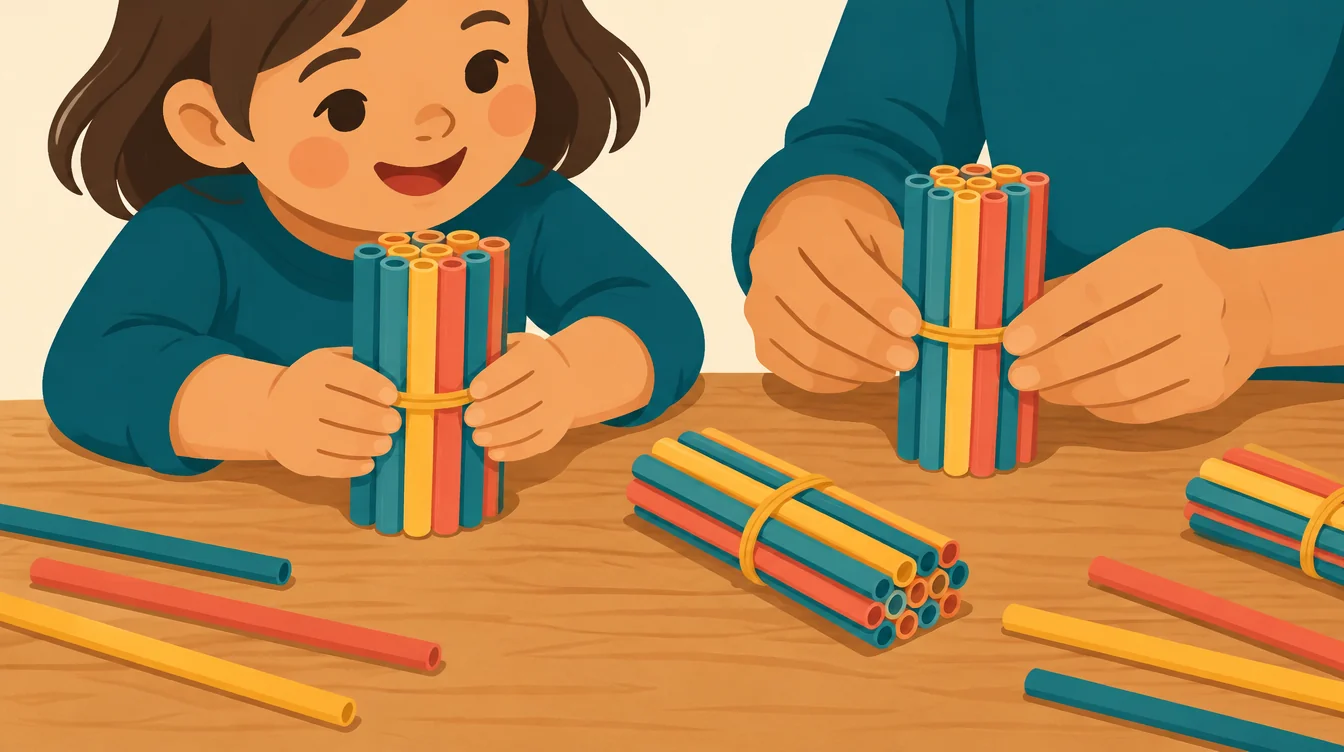
Before using any method, let your child handle objects. Use straws or sticks, and make bundles of 10 with an elastic band.
- 52 means 5 bundles of 10 and 2 single sticks.
- You want to take away 27: that’s 2 bundles and 7 single sticks.
- Only 2 single sticks? Break open a bundle: now you have 4 bundles and 12 single sticks.
- Take away 7 sticks (leaving 5), then 2 bundles (leaving 2). Result: 2 bundles and 5 sticks, so 25.
The breaking apart method: splitting a ten
This is exactly what you just did with the sticks, but written down. For 52 − 27:
- Units: 2 − 7, not possible. You ‘break’ one of the 5 tens above: cross out the 5 and write 4 above; the 2 becomes 12.
- 12 − 7 = 5. Write 5 in the units column.
- Tens: 4 − 2 = 2. Write 2. The answer is 25.
The advantage: it’s easy to understand with objects. The top number doesn’t change, it’s just written differently: 52 is also 4 tens and 12 units.
The compensation method, often used by parents
Often called the ‘classic’ method, this is the ‘carry 1’ approach many adults learned. For 52 − 27:
- Units: 2 − 7, not possible. Add 10 units to the top: 12 − 7 = 5. Write 5.
- Now compensate. Add 1 ten to the bottom: write a small 1 next to the 2 in the tens row below (‘carry 1’).
- Tens: 2 + 1 = 3, then 5 − 3 = 2. Write 2. The answer is 25.
Why does this work? Because you’ve added 10 to both numbers: 52 − 27 gives the same result as 62 − 37. The difference stays the same, just like the age gap between two siblings never changes.
| Breaking apart | Compensation | |
|---|---|---|
| The idea | You swap 1 ten from the top for 10 units | You add 10 to the top and 1 ten to the bottom |
| What you write | Cross out the tens digit at the top and write one less | A small 1 in front of the top units, a small 1 next to the bottom tens |
| Why it works | The top number is just written differently | The difference between the two numbers stays the same |
| Strength | Easy to show with objects | Always the same method, even with zeros |

The zero-in-the-middle trap
Let's take 403 − 158. In the units column, 3 − 8 isn't possible, and there's no ten to break down: the tens digit is 0.
- By breaking down: first, you break a hundred. 4 hundreds become 3 hundreds and 10 tens. Then you break one of those tens: you're left with 9 tens, and the units become 13. Now 13 − 8 = 5, 9 − 5 = 4, 3 − 1 = 2. Result: 245.
- By compensation: you keep the same steps. 13 − 8 = 5, carry 1; 5 + 1 = 6, and 0 − 6 isn't possible, so 10 − 6 = 4, carry 1; 1 + 1 = 2, and 4 − 2 = 2. Result: 245.
With the breaking-down method, this zero is where mistakes happen most. Go back to the physical materials: you can't open a pack of 10 that doesn't exist, you have to open a pack of 100 first.
Check a subtraction with addition
Subtraction is the opposite of addition. To check: result + bottom number = top number.
- 52 − 27 = 25: 25 + 27 = 52. That's correct.
- 403 − 158 = 245: 245 + 158 = 403. That's correct.
Two more habits that help avoid mistakes: the answer can't be bigger than the starting number, and rounding gives you an idea of the size. 403 − 158 is about 400 − 160, so roughly 240: if you get 345, that's a warning sign. This number sense is also practised in mental maths in CE1.
5 worked subtractions with carrying
Write these out on squared paper, using your child's class method. The answers are checked with addition.
- 64 − 28 = 36. Carry in the units column (14 − 8 = 6). Check: 36 + 28 = 64.
- 81 − 47 = 34. Carry in the units column (11 − 7 = 4). Check: 34 + 47 = 81.
- 352 − 128 = 224. Carry in the units column (12 − 8 = 4). Check: 224 + 128 = 352.
- 534 − 278 = 256. Two carries, in units then tens. Check: 256 + 278 = 534.
- 600 − 245 = 355. Two zeros in the middle: the trickiest case. Check: 355 + 245 = 600.
To go further, our free printable worksheets for subtractions in CE1 and column subtractions in CE2 are available. Subtraction comes up again at every stage of long division, so it's worth making sure it's solid. And for a daily maths moment, try the free Filoumi 31-Day Adventure.
Want to put these tips into practice?
Every day, a new adventure workbook adapted to your child's school level — to print or do on screen. No commitment.
Your questions
Which subtraction method with carrying is taught at school?
Both exist: the breaking-down method and the compensation method. The curriculum asks that only one is used in a given school, from CE1 to CM2. Check your child's workbook or ask the teacher.
In which year do children learn column subtraction with carrying?
In CE1. The curriculum introduces the technique by period 3 at the latest, between the Christmas and winter holidays. It's then reinforced in CE2 with larger numbers.
My child works out 7 − 2 instead of 2 − 7 — what should I do?
This is the most common mistake. Go back to the materials: with just 2 sticks, you can't take away 7, so you need to break a pack of 10. Then have your child check each answer with addition.
How do you check a subtraction?
Add the answer and the bottom number: you should get back to the top number. For 52 − 27 = 25, calculate 25 + 27 = 52.
Read next
 Parent guide
The "summer slide": why your child forgets, and what to do
Loss of skills during school holidays is not inevitable: here’s how to avoid it in 10 minutes a day, without ruining the…
 Revision methods
Printable Kindergarten Activities: November Plan
Printable kindergarten worksheets for November: what the French preschool curriculum covers in period 2, with a simple w…
 Parent guide
Educational gift ideas: a present they'll still use in March
Educational gift ideas for children: 4 tips to avoid toys that end up forgotten, a selection by type and age, and inspir…
 Revision methods
Reading comprehension CE2: helping your child understand what they read
Support your child’s reading comprehension in CE2 with tips on question types, silent reading, unknown words and a simpl…
 Parent guide
Poor school report: how to respond without crushing motivation
Poor school report? Read teachers’ comments, discuss calmly, find the cause and support your child with a plan for small…
 Revision methods
Decimal numbers CM1: understanding the decimal point, with exercises
Help your child in CM1 master decimal numbers: reading, comparing, ordering, and placing decimals, plus 6 corrected exer…