🥞 Proportionality in CM2: explaining it with a pancake recipe
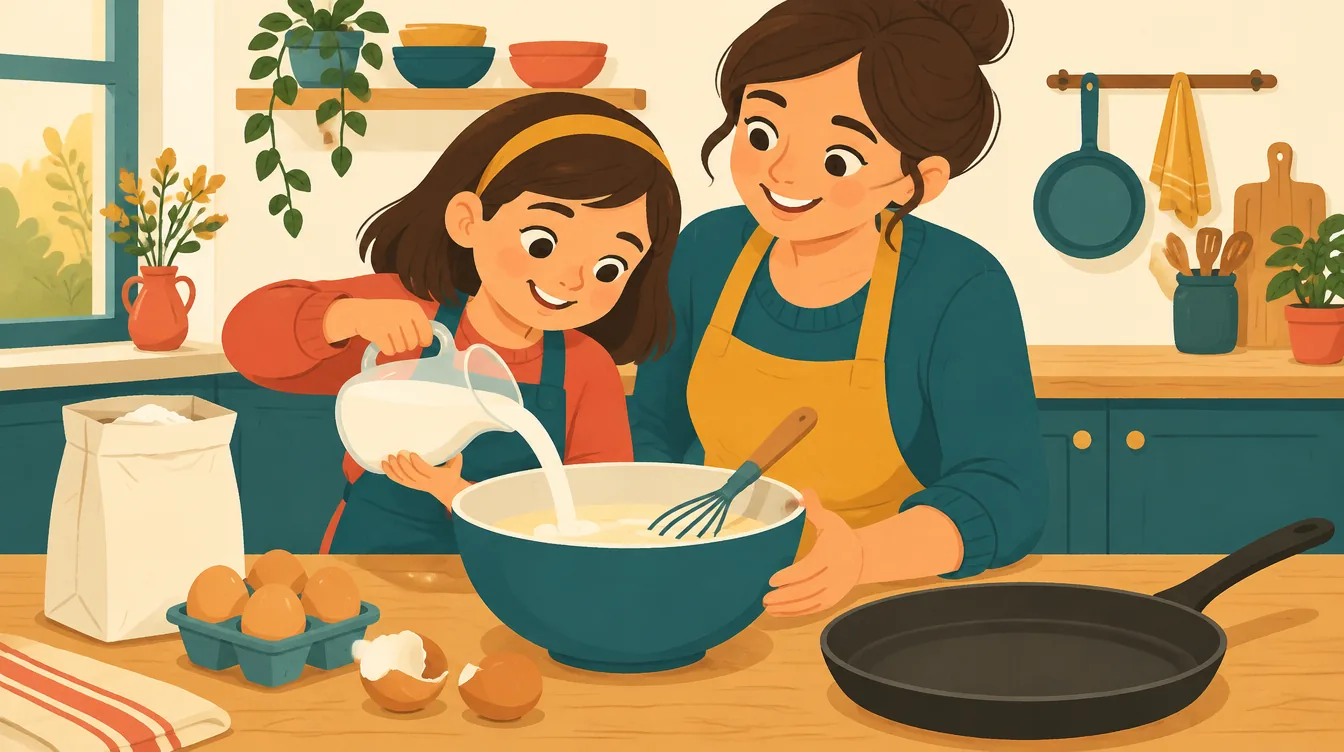
“If there are eight of us at home on Sunday, how much flour do we need for pancakes?” Without realising it, you’ve just asked a proportionality question—one of the key maths topics in CM2. And your kitchen is the perfect place to explain it.
No need for formulas: proportionality is easy to grasp with a recipe, a bit of shopping, and a simple sentence said out loud. Here’s how to do it, following what’s expected at school today.
What is proportionality? The pancake recipe
Two quantities are proportional when, if you multiply one by 2, 3 or 4, the other is multiplied by the same number. Let’s take our pancake recipe for 4 people:
- 200 g flour;
- 4 eggs;
- 40 cl milk;
- 40 g melted butter, and a pinch of salt.
For 8 people, that’s twice as many: you double everything—400 g flour, 8 eggs, 80 cl milk, 80 g butter. For 2 people, halve everything: 100 g flour, 2 eggs, 20 cl milk, 20 g butter. The amount of each ingredient is proportional to the number of people.
This practical context is important: in CM1 and CM2, proportionality is always taught using real quantities (grams, euros, people), never just with numbers on their own. That’s what the official CM2 curriculum documents, updated for the 2026 school year, make clear.
Is it proportional? Learning to recognise it
Before calculating, you need to know if the situation is proportional. One question is enough: “If I take twice as much, do I get twice as much?”
- Yes for the price of identical baguettes, the weight of a stack of identical books, or the ingredients in a recipe.
- No for age and height: at 16, you’re not twice as tall as at 8.
- No for a “3 for the price of 2” offer: three packs don’t cost three times the price of one.
A classic pitfall, mentioned in the official documents, looks like a real proportionality problem: “An orchestra of 20 musicians plays a piece in 24 minutes. How long does it take an orchestra of 40 musicians?” Still 24 minutes! Doubling the musicians doesn’t double the length of the piece.

4 ways to find the missing number
In CM2, your child learns several ways to reason and picks the most practical one for the numbers involved. Still using our recipe for 4 people:
| The method | The example | The sentence to say |
|---|---|---|
| Times more, times less | Flour for 12 people | “12 is 3 times 4, so 3 times more flour: 3 × 200 g = 600 g.” |
| Add | Milk for 6 people | “6 is 4 + 2, so 40 cl + 20 cl = 60 cl.” |
| Mix the two | Butter for 10 people | “8 is 2 times 4: 80 g. 2 is half of 4: 20 g. 80 g + 20 g = 100 g.” |
| Go via one person | Flour for 7 people | “For 1 person: 200 g ÷ 4 = 50 g. For 7: 7 × 50 g = 350 g.” |
The first three methods are central to the CM2 curriculum. Going via one person is especially useful when the numbers don’t fit together neatly, like from 4 to 7 people. In class, what matters most is that your child can explain why they’re multiplying, not just give the answer.
The proportionality table—no rush, no stress
Many parents learned proportionality with a two-row table, a “coefficient”, and cross-multiplication. The current curriculum takes a different approach: no proportionality table in CM1 or CM2, no coefficient, no cross-multiplication. The table is introduced in 6e, with each quantity and its unit, and cross-multiplication comes later in middle school.
Why? Because learning a technique too early encourages calculation without understanding. A child who can say “twice as many people, so twice as much flour” will be able to use a table in 6e; the other way round isn’t true.
Percentages and scales: coming up in middle school
Percentages and map scales are also examples of proportionality. With the new curriculum, these are covered in middle school: for example, learning about scales is part of the 6e (first year of middle school in France) programme. On a map with a scale of 1/100,000, 1 cm represents 100,000 cm, which is 1 km.
Is your child curious? Simple percentages are easy to understand using the fractions they already know: 50% is half; 25% is a quarter; 10% is a tenth. Our percentages worksheet lets you get ahead, and our article on decimal fractions links this to tenths and hundredths. For the rest of what’s coming up, see how to prepare for 6e.
Worked problems to try while cooking
Still using the recipe for 4 people (200 g flour, 4 eggs, 40 cl milk, 40 g butter).
- There are 12 of you at the table. How much flour do you need?
- There are 6 of you. How much milk?
- There are 10 of you. How many eggs?
- There are 7 of you. How much butter?
- A pancake takes 2 minutes to cook. How long does it take to cook 3 pancakes at the same time, using 3 pans?
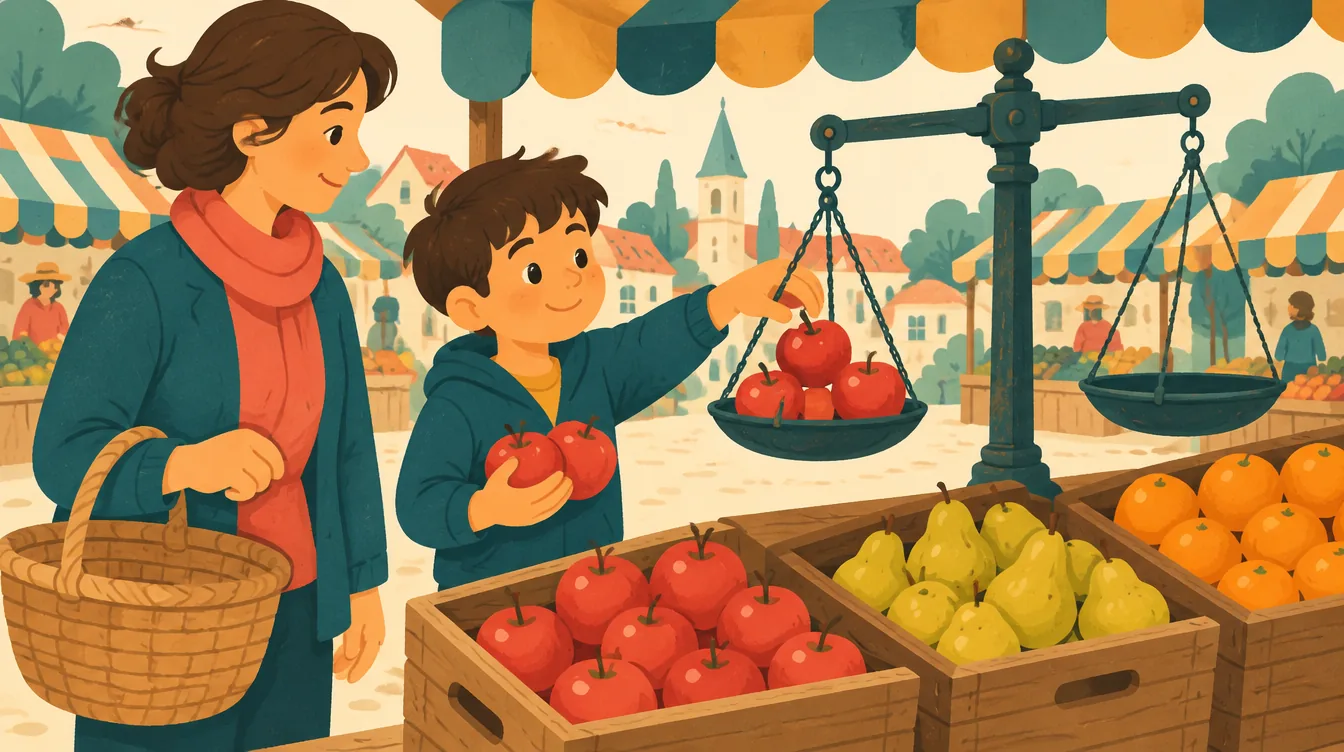
- At the market, 3 kg of apples cost €6. How much for 5 kg?
Answers: 1. 600 g (3 times more); 2. 60 cl (40 + 20); 3. 10 eggs (8 + 2, or 1 egg per person); 4. 70 g (10 g per person); 5. still 2 minutes: it’s not proportional! 6. 1 kg costs €2, so 5 kg cost €10.
To practise online or on paper, our proportionality CM2 worksheet offers exercises with answers and a printable PDF. And for a daily challenge, sign up for the 31-Day Adventure: a free workbook by email, matched to your child’s level, up to CM2.
Want to put these tips into practice?
Every day, a new adventure workbook adapted to your child's school level — to print or do on screen. No commitment.
Your questions
What is a proportionality situation in CM2?
It’s when two quantities change together: if one is multiplied by 2, 3 or 4, so is the other. Recipe ingredients and number of people, or price and number of identical items, are examples.
Does my child need to know cross-multiplication in CM2?
No. In CM2, the focus is on ‘times more, times less’, addition or working through the unit. The proportionality table comes in 6e, and cross-multiplication is taught later in middle school.
How do you know if two quantities are proportional?
Ask: “If I take twice as much, do I get twice as much?” Yes for the price of identical baguettes, no for age and height or for a ‘3 for 2’ offer.
Are percentages part of the CM2 curriculum?
With the cycle 3 curriculum applied in CM2 from September 2026, percentages are covered in middle school. However, your child can still understand the simplest ones using fractions: 50% is half.
Read next
 Parent guide
The "summer slide": why your child forgets, and what to do
Loss of skills during school holidays is not inevitable: here’s how to avoid it in 10 minutes a day, without ruining the…
 Revision methods
The subject complement: how to spot it easily, from CM2 to 6e
Learn to identify the subject complement in CM2-6e with a simple definition, a rhyme for state verbs, and 2 tests to avo…
 Parent guide
Educational gift ideas: a present they'll still use in March
Educational gift ideas for children: 4 tips to avoid toys that end up forgotten, a selection by type and age, and inspir…
 Revision methods
Written multiplication: step-by-step method, from CE2 to CM2
Written multiplication: a step-by-step guide for one- and two-digit numbers, where to put the carries, the zero on the s…
 Parent guide
Poor school report: how to respond without crushing motivation
Poor school report? Read teachers’ comments, discuss calmly, find the cause and support your child with a plan for small…
 Revision methods
Subtraction with borrowing: both methods explained for parents
Subtraction with borrowing: breaking down and compensation methods explained with the same example, the zero trap, and 5…