1. Pat the Cat
Sound: aPat is a cat. Pat sits on a mat. Sam has a hat. Pat taps the hat: tap, tap! Then Pat sits in it. Now Sam has a hat and a cat!
Now I answer
- Who is Pat?
- Where does Pat sit first?
- Where does Pat sit at the end?
A booklet of 14 illustrated pages to read syllables, discover “sh” and “ch”, match words to images and understand a short story. Free PDF, immediate, no email. Answers and adult guide included.
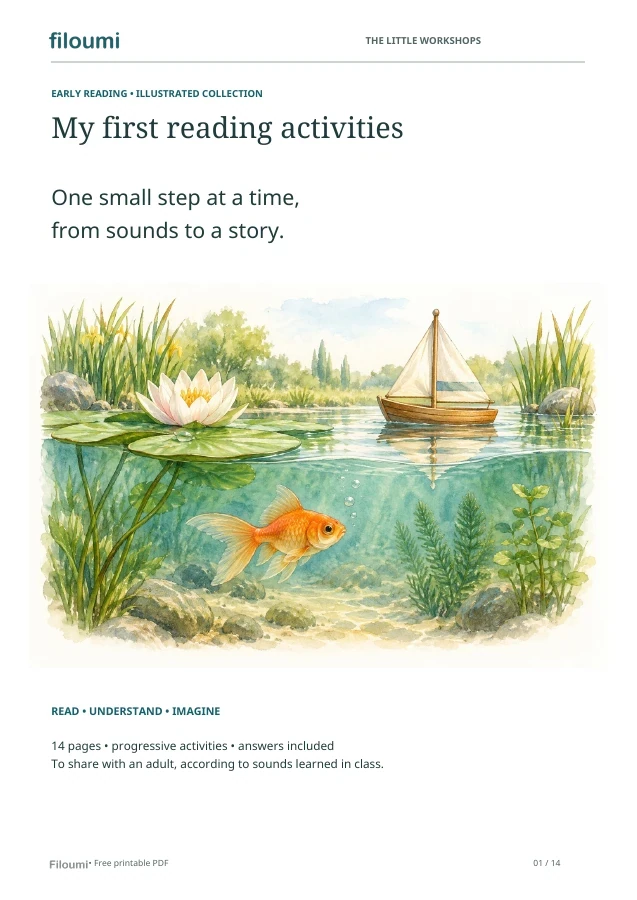
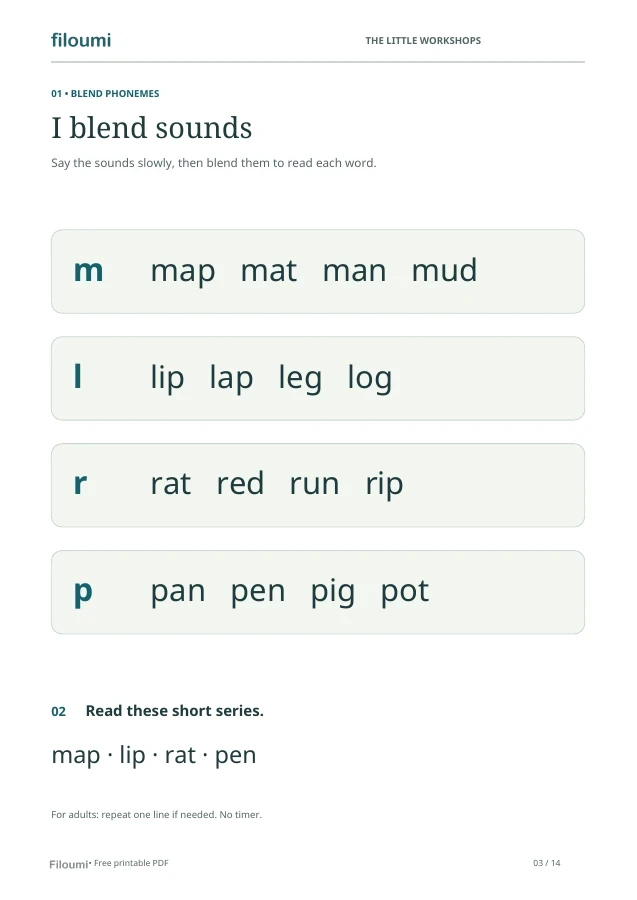
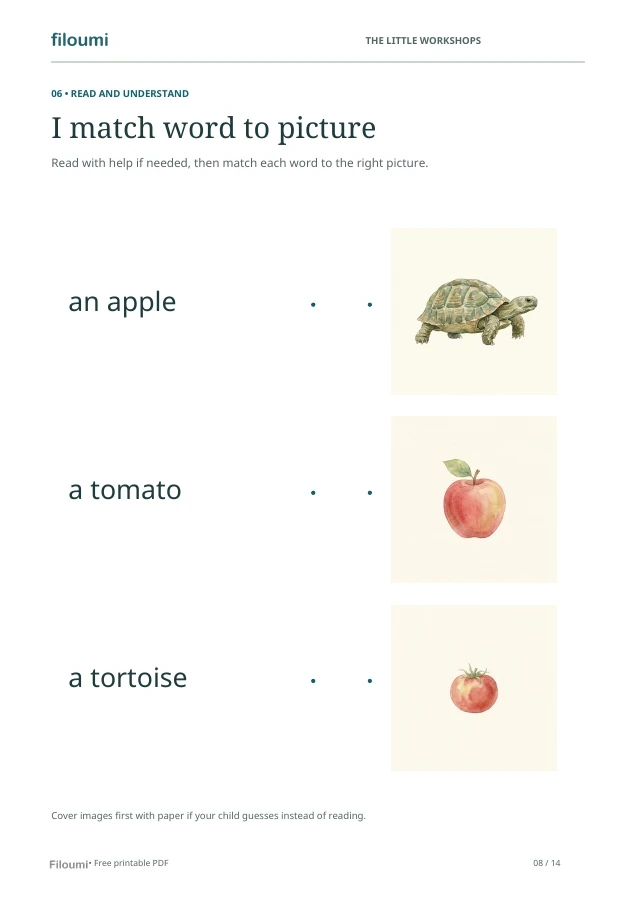
Here are three pages from the booklet you will download. The activities use large fonts, watercolor illustrations, and wide spaces to answer or draw.
Download the free PDF · 14 pages
Choose the sounds already studied in class. The adult reads the instructions and supports the still difficult words. Print in A4, at 100%, only the useful pages.
The exercises remain usable in black and white. The cover is optional.
A complementary support, to adapt to your child. Also see the free CP exercises and cards to enrich vocabulary.
In CP (first year of primary school, ages 6-7), your child learns to connect letters to sounds, to read words, then to understand what they read. This booklet offers short activities to choose according to the class progression. The adult supports the instructions and still unknown words; each progresses at their own pace.
An adult guide and answer keys accompany the activities: you can check the answers together.
Read ma, mi, mo… and combine syllables to form words.
Identify sh and ch, then listen for these sounds in words.
Read words with help if needed and match them to the correct image.
Draw a sentence, reorder the words, and understand a short story.
Twelve short stories for children aged 6-7 who are learning to read, one per sound, in the order they usually meet them at school. Each passage is five or six short sentences long and ends with three comprehension questions. Everything fits in a free 13-page PDF, answers included.
| Time of year | Sounds | Passages |
|---|---|---|
| Autumn (Sept-Oct) | a, i, o | 1 to 3 |
| Late autumn (Nov-Dec) | ck, e, u | 4 to 6 |
| Winter (Jan-Feb) | h, l, sh | 7 to 9 |
| Spring and summer (Mar-Jun) | ch, th, ee | 10 to 12 |
This is the most common order; follow the one used at your child's school.
Pat is a cat. Pat sits on a mat. Sam has a hat. Pat taps the hat: tap, tap! Then Pat sits in it. Now Sam has a hat and a cat!
Now I answer
Tim and Nan sit on a mat. It is a picnic! Nan has a tin. Tim tips the tin: out come six figs… and an ant! The ant has a picnic too.
Now I answer
Tom has a dog called Dot. One day, Dot got Dad's sock! Tom ran and ran, but Dot did not stop. At last, Dot sat on a log. Dad got his sock back… all wet!
Now I answer
Jack has a sack with a snack in it. He sits on a rock by the pond. A black duck pecks at the sack: peck, peck! Jack tips the snack onto the grass. Quack, quack: that is duck for “Thanks, Jack!”
Now I answer
Meg has a red hen called Peg. Peg sits on her nest in the shed. Meg and Ben wait and wait. At last, Peg gets up. In the nest, there is an egg! Peg gets a pat, and Meg gets the egg.
Now I answer
Russ has a pig called Gus. Gus runs in the sun. Then he jumps in the mud! Russ puts him in the tub: rub, rub, rub! Now Gus is pink and clean. But he runs back to the mud!
Now I answer
Hal and Holly play hide and seek. Holly hides in the hut. Hal hunts and hunts. He looks on the hill and by the hens. Then he spots a hat by the hut: it is Holly's hat! “Got you!” says Hal, and they hug.
Now I answer
Lily has a little doll called Lulu. Oh no, Lulu is lost! Lily looks in the hall, on the bed and under the lamp. Then she hears a giggle: little Leo has Lulu! Lulu has a lollipop in her hand. Lily laughs: “Lulu, you look lovely!”
Now I answer
Josh and Sasha sail on a little ship. Josh dips his net in the sea and gets a shell. Sasha says: “It is a wish shell!” Josh shuts his eyes and makes a wish. Then, splash, a fish jumps up next to the ship! Josh grins: his wish was to see a fish.
Now I answer
Chad and Mitch have lunch on a bench at the farm. Chad has a sandwich and a bag of chips. A little chick hops up to the bench: cheep, cheep! Then, chomp, the chick snatches a chip and runs off! Chad and Mitch chuckle: what a cheeky chick!
Now I answer
It is bath time for Beth. She gets in the bath with three toy boats. Then a little moth lands on the tap. Beth thinks: “Does this moth want a bath too?” But the moth flutters off: moths do not like baths! Beth laughs: “Then this bath is all for me!”
Now I answer
Lee plants three seeds in a pot. Each week, she gives them a little water. Soon, she sees three green shoots. Then three yellow flowers peep out! A bee zooms in and buzzes: “Thank you, Lee!”
Now I answer
This is the question all parents ask themselves in September. Here, clearly, are the steps of learning to read, and where our worksheets come in.
Before knowing the letters of the alphabet, the child must hear the phonemes: the sounds that make up words. This phonological awareness, built up from preschool onwards (age 3-6), prepares the decoding work at the heart of learning to read in CP.
B and A make BA. This is the reading method recommended today by the French Ministry of Education, and the one our worksheets follow. The child assembles, they decode — they do not guess. The decoding is slow at first, then becomes automatic.
It asked children to memorise whole words by their shape. It has largely been abandoned: research has shown that the classic alphabetic and syllabic approach works better for all children. Today, most classes use a syllabic teaching method, sometimes with a touch of memorising key words.
Children learn to read and write at the same time: tracing a letter in cursive helps them recognise it. That is why reading and writing progress together in CP, and some worksheets suggest writing the words or sentences just read, with help if needed.
Ten minutes a day of playful, educational activities are better than an hour on Sunday. As with music theory, you struggle to decode at first, then one day it flows naturally: that's the magical moment when the child has learned to read — and when they begin to read to learn.
Learning rhythms vary. If reading remains very difficult, if your child suffers or if you are worried, talk with their teacher and doctor without waiting for a class deadline. The doctor can guide towards useful assessments. Identification and diagnosis: explanations from the Health Insurance.
Choose a worksheet adapted to the sounds already studied in class. Read together, then pause whenever your child needs.
Leave your email and receive one playful exercise a day for 31 days, matched to your child’s level, from Kindergarten to CM2 — online or as a PDF to print. 100% free.
🎁 Start the 31 days → No commitment · unsubscribe with 1 clickThe PDF opens immediately, no email or registration required.
A4 format at home. Ready-to-use, colourful worksheets.
A short activity according to their desire and the sounds studied in class.
Yes, 100%. It's a free PDF to download and print immediately, no email and no registration required.
For children in CP (6-7 years old) who are learning to read, from simple syllables to first sentences.
You can alternate syllables, words, and short sentences according to the class progression. Comprehension counts as much as decoding; no single duration suits all children.
No, these worksheets are free and will stay free. The 31-Day Adventure for CP, also free, does something different: every morning for 31 days, an adventure workbook with Plouf arrives by email, with nothing to remember.
Right here: 12 short reading passages for children aged 6-7, sorted by sound, each with three comprehension questions and an answer key. They download as one free 13-page PDF, with no email and no sign-up.
The complete workbook to print to review a selection of CP concepts before CE1.
Free workbooks for each level, from preschool to CM2 (10-11 years old).
One notebook each morning for 31 days with Plouf — reading, maths, and games, entirely free.
📥 CP exercises to print →Download the free CP reading worksheets now — immediate PDF, no email required. Your child can start tonight.
📥 I download the free worksheetsChoose the difficulty according to what your child already reads: syllables, words, then short sentences. This progression allows returning to a simpler step when reading still requires much effort.
Print only the useful pages. You can redo the same worksheet another day, without trying to go fast.
Download the CP reading worksheets in PDF
To vary: the CP workbook and exercises by level.
Your child is progressing in reading and you are also looking for tips to remember their lessons? Discover the Primary Reminders, from CP to CM2, offered as a paper book or paid PDF. Check the presentation and formats to choose according to their needs.
One playful exercise a day by email, from Kindergarten to CM2, online or as a PDF to print. Unsubscribe any time.
Start the 31 days →Our commitments, black on white
No empty promises: only what we deliver.
Printed on demand
Our paper books are made to order, in Europe: expect 2 to 5 working days for printing, then shipping.
Free delivery
Free shipping in mainland France, with no minimum order.
Free reprint
A printing defect on your copy? We will reprint it at our expense.
14 days to change your mind
The legal withdrawal period applies to all paper book orders.
No subscription
The 31-day Adventure is now free, and our books are sold individually: no subscription, no recurring charges.
Trademark registered at INPI
Filoumi is an independent French brand, registered at INPI.
PDF · immediate downloadFree workbook without email or registrationDesigned in France, from Preschool (3-4 years) to CM2 (10-11 years)